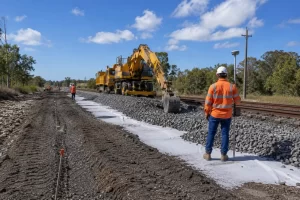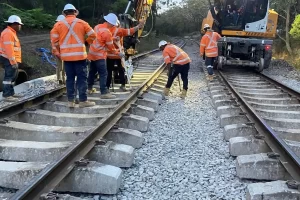
Stormwater rail infrastructure protects track formation, structures, access roads and adjoining land by directing runoff through a controlled drainage system. In a rail corridor, poor water management can soften formation materials, contaminate ballast, erode batters, block access and increase the maintenance burden on the operating asset.
Effective drainage is therefore not an isolated civil work. It must respond to catchment flows, corridor geometry, track levels, ground conditions, environmental obligations and interfaces with roads, utilities, bridges and neighbouring properties. It also has to remain inspectable and maintainable after construction.
This guide explains the role of stormwater infrastructure in rail corridors, the main components used, the construction sequence and the practical quality controls that support a reliable handover.
Why stormwater rail systems matter
Rail formation performs best when surface water and groundwater are kept away from the load-bearing layers beneath the track. Where runoff ponds beside the formation or flows uncontrolled through ballast, fine material can migrate, shoulders can scour and wet spots can develop. Repeated wetting may then contribute to geometry defects, speed restrictions or more frequent maintenance.
A coordinated stormwater rail system collects water, conveys it along or beneath the corridor and discharges it at an approved location. The system also needs erosion protection and sediment control so it does not simply transfer a problem downstream.
Drainage planning must be based on the project design and the asset owner’s requirements. Catchment size, rainfall, hydraulic capacity, flood behaviour, scour risk and downstream constraints are engineering matters. Construction teams deliver the approved arrangement and record any site conflicts for resolution rather than changing flow paths informally.
Core stormwater infrastructure in rail corridors
Rail drainage is usually a connected network rather than a single asset. Each component performs a specific task, and the complete system is only as effective as its weakest transition, outlet or maintenance point.
Table drains and open channels
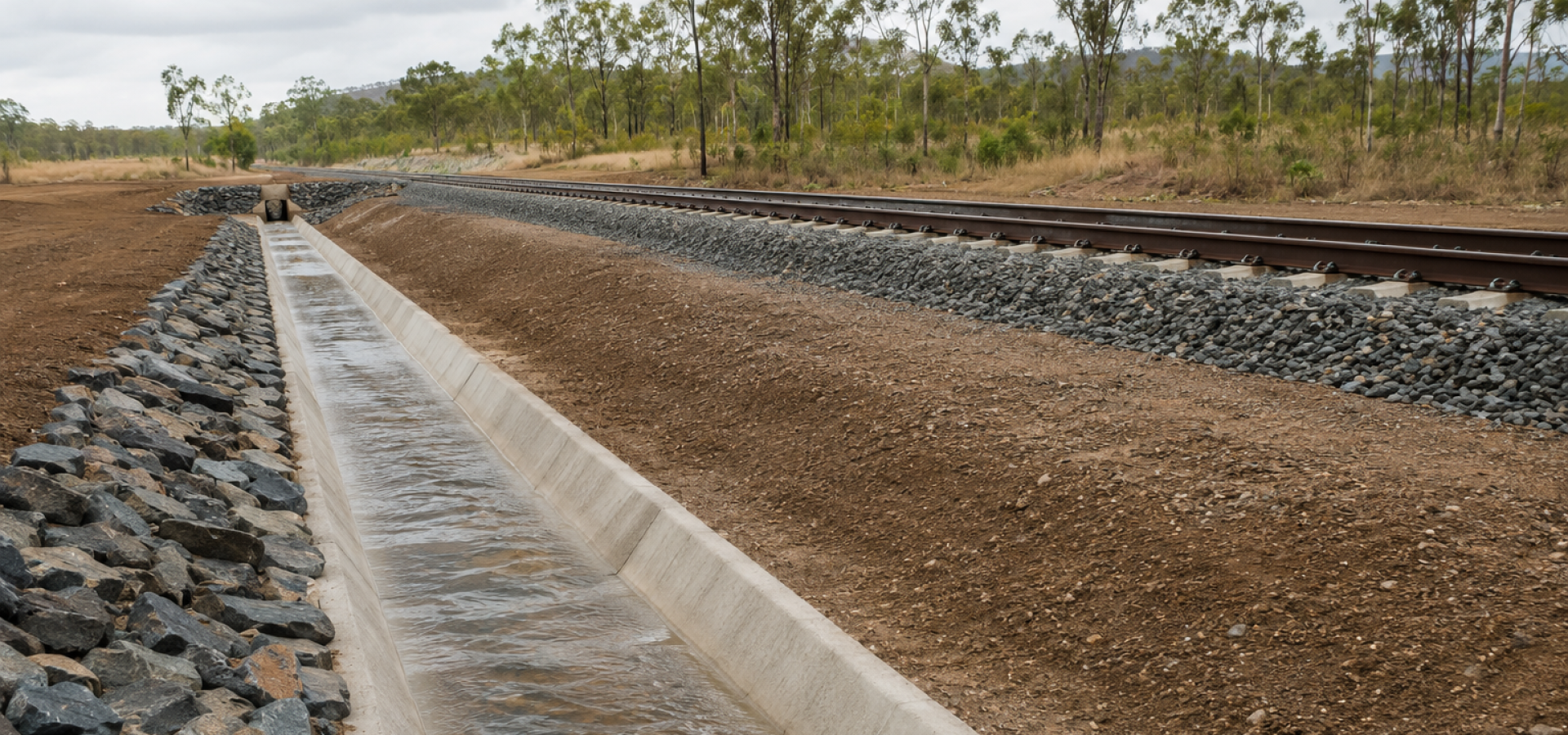
Open drains intercept and convey surface runoff along the corridor. Their line, grade and cross-section need to match the approved design so water continues to move without eroding the drain or overtopping towards the track. Linings, check structures or rock protection may be required where velocity or soil conditions create a scour risk.
Subsoil and formation drainage
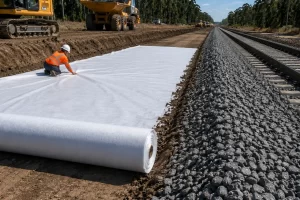
Subsoil drains collect water within or beside the formation where surface drains alone are insufficient. Filter material, geotextile, perforated pipe and outlet details must be installed without contamination or blockage. A drain that cannot discharge freely will not provide the intended benefit.
Scour and erosion protection
Rock pitching, aprons, energy-dissipation treatments and vegetation may be used to protect drains, batters and discharge points. The selected treatment must follow the approved design. The objective is to control velocity and prevent soil loss without obstructing the drainage path.
These protective measures should be inspected after installation and following significant rainfall to confirm they remain stable and effective. Displaced rock, localised scour, sediment build-up or blocked outlets should be addressed promptly before erosion reaches the track formation or reduces the drainage system’s capacity.
Culverts and cross-drainage
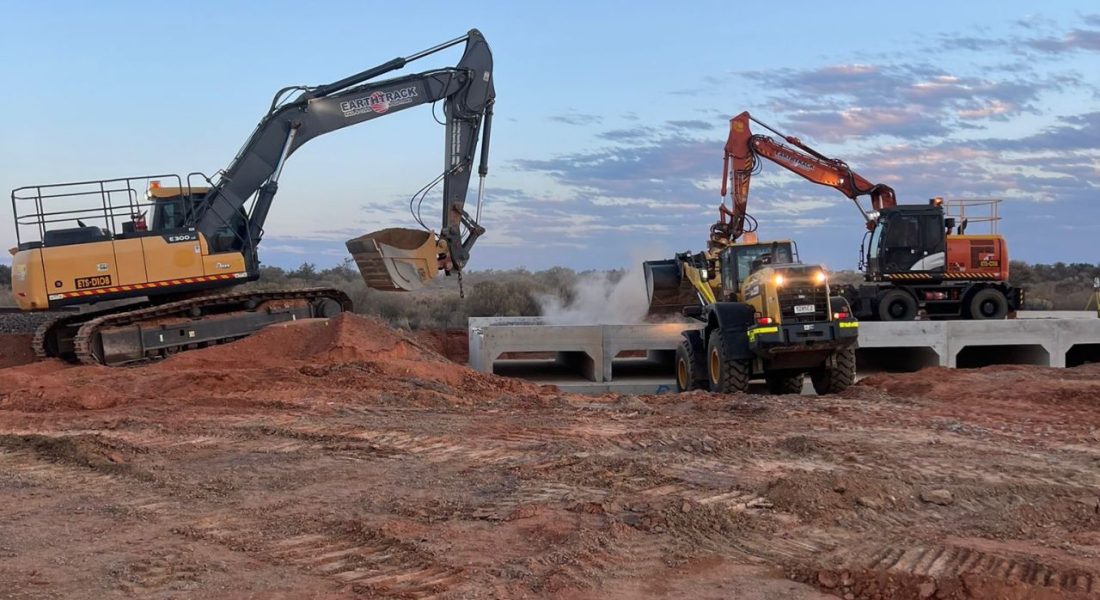
Culverts transfer water beneath the railway, access roads or other corridor infrastructure. Installation must protect line, level, joint integrity, bedding and structural support. Inlets and outlets need stable transitions because concentrated discharge can cause undermining or erosion if energy is not managed.
Pits, headwalls and outlets
Pits provide collection, transition or maintenance access points. Headwalls, end treatments and outlet protection stabilise pipe ends and help control flows entering or leaving the system. Covers, grates and structures must suit the nominated loading and remain accessible for inspection.
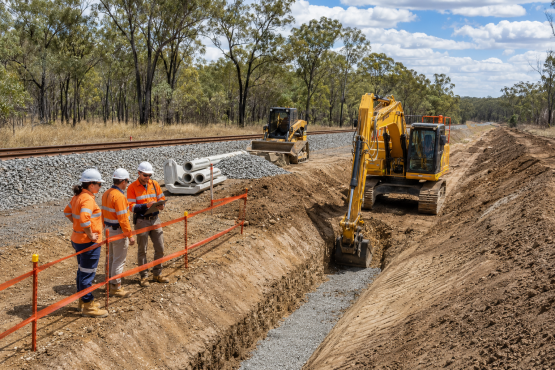
Planning drainage work in an operational rail environment
Rail-corridor drainage work often takes place beside live track, existing services and constrained access routes. Planning should start with the current design, asset information, environmental requirements, rail access conditions and inspection and test plan. The program must also account for wet weather and temporary drainage while permanent assets are incomplete.
ARTC’s guidance for external parties entering its rail corridor identifies stormwater movement to or beneath the corridor as an interface that must be considered during and after construction. The practical lesson is broader: drainage changes near rail infrastructure require asset-owner review and project-specific approval, not a site-only decision.
- Confirm approved drawings, drainage schedules, specifications and current revisions.
- Review catchment assumptions, flow directions, levels and nominated discharge points.
- Locate existing utilities, signalling routes, culverts and other underground assets.
- Coordinate drainage with track formation, structures, access roads and adjacent properties.
- Plan rail protection, permits, possessions or isolations required by the work package.
- Provide temporary controls so incomplete work does not direct water towards the track.
- Define hold points, survey requirements, tests and handover evidence before excavation.
Stormwater rail construction process
The exact sequence depends on the asset type and access strategy. However, a controlled workflow keeps the drainage function visible throughout construction and gives the team clear opportunities to identify conflicts before reinstatement.
1. Verify set-out and existing conditions
Survey establishes the drainage alignment, structure locations, invert levels, grades and tie-in points. The team should also inspect the existing catchment and drainage path. Standing water, blocked assets, unexpected outlets or evidence of scour may reveal conditions that need design review.
2. Locate and prove services
Existing services must be identified using available records and the approved locating and proving process. Rail corridors can contain signalling, communications, power and legacy services that are not obvious at ground level. Excavation should proceed only under the relevant controls and asset-owner conditions.
3. Establish environmental and temporary drainage controls
Before disturbing soil, the work area needs the erosion, sediment and water-diversion controls required by the environmental plan. These controls may change as the excavation advances. They should be inspected after rainfall and maintained so sediment does not enter live drainage systems or nearby waterways.
4. Excavate and prepare foundations
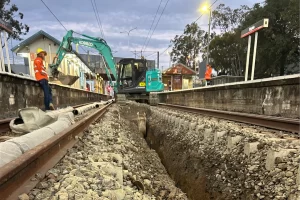
Excavation is completed to the approved geometry while controlling ground stability, water ingress, mobile plant and access. Foundations and bedding must be uniform and suitable for the specified pipe, culvert, pit or channel. Soft spots, unexpected groundwater or unsuitable material should be addressed through the approved process.
5. Install drainage structures
Pipes, culverts, pits, headwalls and channel treatments are installed to the design line and level. Jointing, reinforcement, concrete, filter materials and geotextiles must match the relevant specification. Care is needed to prevent contamination, displaced joints or damage during lifting and placement.
6. Complete inlet, outlet and tie-in works
The drainage path needs a clear connection from collection point to discharge. Inlets should receive the intended flow without creating ponding, while outlets need the nominated scour protection and a stable downstream path. Tie-ins to existing systems require particular care because their condition and level may differ from records.
7. Inspect, test and survey before cover
Hidden elements should be inspected before backfill or concrete cover prevents access. Checks may include line, level, grade, bedding, joints, reinforcement, filter layers, pit dimensions and outlet construction. Survey and photographic records should be captured at this stage, together with the results required by the inspection and test plan.
8. Backfill, compact and reinstate
Selected backfill is placed and compacted without moving or damaging the installed asset. Reinstatement then restores formation interfaces, access roads, batters, fencing and other disturbed areas. Temporary erosion and sediment controls remain until the site is stable and the permanent drainage path is functioning.
Safety and environmental controls
Stormwater construction combines excavation, lifting, concrete work, mobile plant and water-related hazards. Safe Work Australia classifies trenches, holes and cavities as excavation work and notes that excavation risks must be managed under the applicable work health and safety framework. Site controls must be based on the actual depth, ground conditions, access and nearby infrastructure.
Rail requirements add another layer. Workers, plant and materials must remain within the authorised work area and follow the protection, permit and communication arrangements set by the rail infrastructure manager and principal contractor. Weather monitoring is also important because rainfall can rapidly change excavation stability, access and flow conditions.
Environmental controls are part of construction quality. Queensland TMR identifies drainage design guidance alongside erosion and sediment controls for managing soil and water risks. On rail projects, the applicable asset-owner and project documents take precedence, but the same principle applies: permanent drainage and temporary environmental controls must be planned together.
Quality checks for reliable drainage
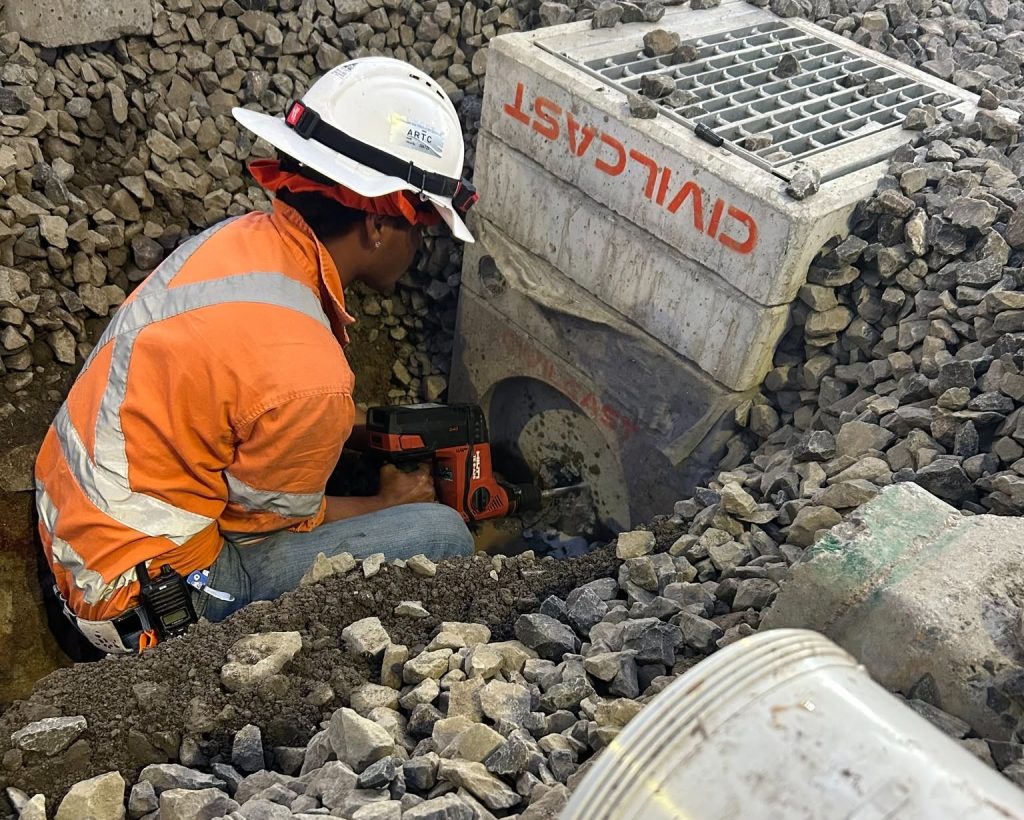
Drainage defects can remain hidden until the next significant rainfall. Progressive inspection reduces that risk by confirming the system while levels, joints and foundation details are still accessible. It also creates a clear record for handover.
- Approved materials, products and structure types are used.
- Set-out, invert levels, grades and flow direction match the design.
- Foundations, bedding, joints, reinforcement and concrete meet the specification.
- Pits, culverts and channels connect without steps, obstructions or unintended low points.
- Subsoil drainage filter layers remain clean and connected to a functioning outlet.
- Inlets accept the intended flow and outlets include specified scour protection.
- Backfill and compaction evidence is complete where required.
- As-constructed survey, inspection, test and photographic records are ready for handover.
Common rail corridor drainage challenges
Limited access can make drainage work more difficult than the asset itself suggests. Long reaches, steep batters, soft ground and restricted possession windows influence plant selection, spoil handling and delivery sequencing. A constructible plan should consider how materials, workers and equipment reach each workface safely.
Unknown conditions are another frequent issue. Existing culverts may be partly blocked, outlets may sit at different levels from survey records, and buried services can constrain the designed route. These conditions need timely escalation because small changes in invert or alignment can affect the hydraulic result.
Wet weather creates both urgency and risk. Temporary measures must protect the operating railway while excavations are open, yet crews should not improvise permanent diversions without approval. Clear weather triggers, inspection responsibilities and contingency actions help the team respond consistently.
Maintenance access and whole-of-life performance
A drainage asset must remain serviceable after construction. Pits, grates, culvert ends and channels should be accessible for inspection and clearing, subject to the rail corridor’s access controls. Vegetation, sediment, litter and local erosion can reduce capacity over time, even where the original installation was compliant.
Handover information supports this maintenance task. Accurate asset locations, invert levels, photographs and approved deviations help future teams understand where water should flow and which components require attention. They also reduce the risk of damaging hidden drainage during later corridor works.
Supporting rail drainage delivery
Matrix Unlimited supports defined rail construction, civil drainage and maintenance work packages with labour, plant, operators and supervision. This integrated model can help principal contractors, rail operators, alliances and infrastructure delivery teams coordinate drainage activities with formation rehabilitation, track renewal, access and surrounding civil works.
Delivery requirements vary between greenfield, brownfield, shutdown and possession environments. Early planning should confirm the scope, access window, plant, competencies, supervision, environmental controls, quality documentation and interfaces with other contractors. That allows resources to be aligned with the approved design without overstating the package or bypassing engineering responsibility.
Frequently asked questions
Why is drainage important beneath and beside railway track?
Drainage limits the amount of surface water and groundwater reaching ballast, formation and supporting earthworks. This helps protect material strength, reduce erosion and maintain a more stable track environment.
What drainage assets are commonly used in a rail corridor?
Common assets include table drains, lined channels, culverts, pipes, pits, subsoil drains, headwalls and outlet protection. The correct combination depends on the approved hydraulic and civil design for the corridor.
Can a drainage route be changed during construction?
A site conflict should be raised through the project’s technical process. Changes to level, grade, capacity, inlet or outlet location can alter hydraulic performance and downstream impacts, so they require the appropriate design review and approval.
What should be included in drainage handover records?
Typical requirements include inspections, material records, concrete and compaction evidence where specified, test results, photographs and as-constructed survey. The project inspection and test plan defines the final evidence set.
Plan stormwater rail works around the full corridor
Reliable drainage protects more than the immediate work area. It supports formation performance, safe access, environmental compliance and the serviceability of the rail corridor through changing weather conditions. The strongest results come from treating collection, conveyance, discharge, erosion protection and maintenance access as one connected system.
Matrix Unlimited works with Tier 1 contractors, rail operators, alliances, infrastructure delivery teams and government authorities across Queensland and regional project environments. Talk to the team about labour, plant, operators and supervision for your defined rail drainage or civil work package.
Discuss your upcoming rail and civil drainage works with Matrix Unlimited.